Attack on Titan Season 3 Review: All Episodes Explained
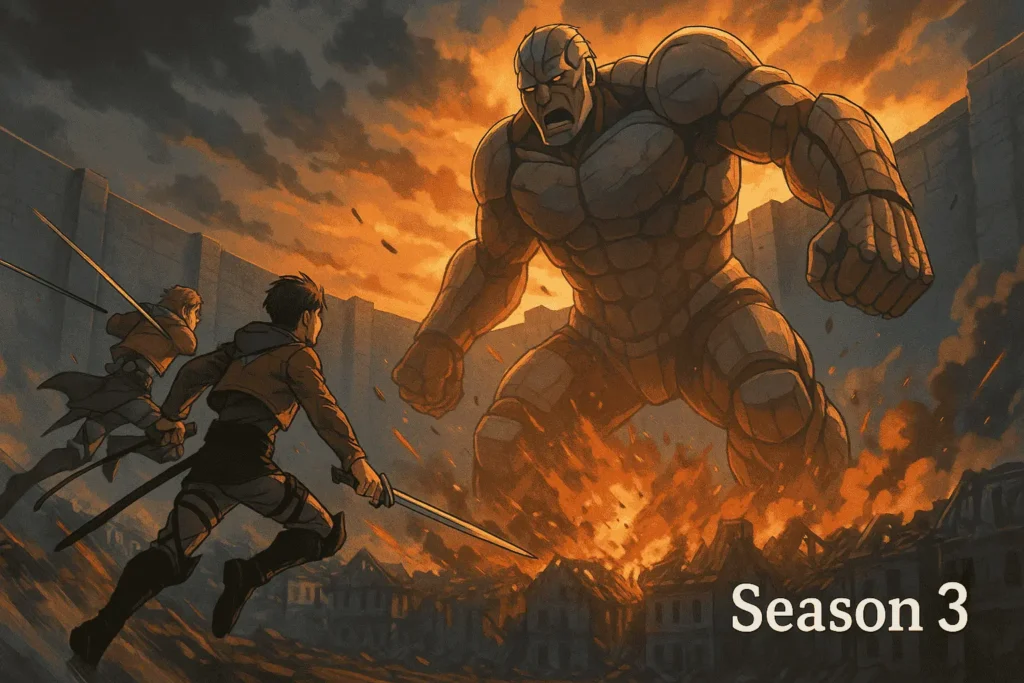
Attack on Titan Season 3 is a thrilling and pivotal chapter in the epic anime series. In our Attack on Titan Season 3 review, all episodes are covered and explained in detail, from the political intrigue within the walls to the high-stakes battles against Titans. This season originally aired in 2018–2019 and is split into two parts, each with its own tone and climax. Spoiler Alert: This overview explains all episodes and key plot points of Season 3, so beware if you haven’t watched it yet.
Season 3 Overview
Attack on Titan’s third season consists of 22 episodes, divided into Part 1 (12 episodes) and Part 2 (10 episodes). Part 1 aired in 2018, and after a brief hiatus, Part 2 concluded in 2019. This season adapts the “Royal Government” arc (also known as the Uprising arc) and the “Return to Shiganshina” arc from the manga. Here’s a quick overview of what to expect in Season 3:
-
Focus on Human Conflict: Early episodes shift focus from fighting Titans to dealing with political corruption and power struggles within the Walls. The Scout Regiment finds itself hunted by the government’s Military Police, highlighting a new human vs. human conflict.
-
New Characters & Revelations: We meet intriguing new characters like Kenny Ackerman (a dangerous assassin with ties to Levi) and Rod Reiss (Historia’s father and the true king). Through them, secrets about the royal family and the origin of Titan powers are revealed.
-
Return to Titan Action: The second half returns to all-out Titan battles as the Scouts attempt to retake Wall Maria. Iconic enemies the Colossal Titan and Armored Titan reappear, led by the Beast Titan in an epic showdown.
-
Major Plot Twists: Season 3 delivers some of the biggest plot twists of the series. From the truth about Eren’s father and the mysterious basement to the revelation of what lies beyond the walls, these episodes reshape the entire story’s direction.
-
Character Growth: Many main characters reach turning points. Eren, Levi, Historia, Armin, and others undergo significant development as they face moral dilemmas and make life-altering choices.
Overall, Season 3 balances intense action with deep lore and character-driven storytelling. Next, we’ll dive into each part of the season and explain how the story unfolds, episode by episode.
Read More: 20 Must-Watch Anime on ToonStream for Beginners
Part 1: Uprising Arc (Episodes 38–49)
Attack on Titan Season 3 Part 1 deals with turmoil inside the Walls and sets the stage for the series’ future revelations. This arc is more politically driven and character-focused, offering a change of pace from constant Titan fights. Here’s what happens in Part 1:
-
Political Coup and Corruption: The Scout Regiment (led by Erwin Smith) discovers that the royal government has been hiding truths about the Titans and humanity. When the corrupt King and nobles threaten to destroy the Scouts, Erwin and Commander Pyxis initiate a coup d’état. They expose the king as a figurehead and install the rightful heir, Historia Reiss, as queen. This storyline explores themes of government propaganda and the morality of leadership, as the Scouts decide it’s worth overthrowing authority to save humanity.
-
Historia & Eren’s Captivity: Early in the arc, Eren Yeager and Historia (formerly known as Krista) are captured by Rod Reiss, Historia’s father. We learn that the Reiss family has passed down the power of the Founding Titan for generations. Rod plans for Historia to inject herself with Titan serum and consume Eren to reclaim this power. These episodes reveal Eren’s father Grisha’s role in stealing the Founding Titan power years ago, and they force Historia to choose her own identity. In a dramatic turn, Historia refuses to follow her father’s plan—shattering the cycle of royal control—and decides to free Eren instead of eating him.
-
Levi vs. Kenny & The Underground Battle: A standout subplot in Part 1 is Captain Levi Ackerman leading his new squad (which includes Eren, Mikasa, Armin, and others) while being pursued by Kenny Ackerman’s elite Interior Police. The violent urban chase through the city’s streets and taverns is one of the most exciting sequences in Part 1. Levi’s past is connected to Kenny (who is revealed to be his uncle), adding personal stakes to their confrontation. Eventually, Levi’s squad and the Military Police clash in an underground chapel where Eren is held. There, we get intense fights with ODM gear versus guns, showcasing the series’ trademark action in a new form (human vs human combat instead of human vs Titan).
-
The Tragic Fall of Rod Reiss: Rod Reiss, desperate after Historia’s rebellion, exposes himself to Titan serum and transforms into a gargantuan, mindless Titan (one of the largest Titans seen so far). In the episode “Ruler of the Walls,” this massive abomination slithers toward Orvud District. The Scouts, now with Historia fighting alongside them, devise a risky plan to blow it up. Historia herself delivers the killing blow to her Titan father, proving her bravery and solidifying her resolve. After this victory, Historia officially takes the crown as Queen of the Walls, gaining public support by humbly interacting with citizens (even playfully punching Levi as a thanks for making her more confident).
-
Aftermath and Hope: With the government purge successful and peace briefly restored inside the walls, the Scouts turn their eyes back to the original threat: the Titans outside. In the mid-season finale (“Night of the Battle to Retake the Wall”), the Survey Corps enjoys one calm night of celebration. The recruits throw a feast (with Sasha going crazy over meat, providing a rare comedic moment) before preparing to embark on the mission to reclaim Wall Maria and explore Eren’s basement. This wraps up Part 1 on a hopeful note, but with an undertone of anxiety for the battles to come.
Review of Part 1: The Uprising arc has a very different feel from earlier seasons. It’s heavy on dialogue, intrigue, and backstory, which some fans appreciated for the world-building, while others missed the constant Titan action. However, Part 1 is critically important to understand the political landscape of Attack on Titan’s world and sets up character motivations. It’s a rewarding build-up that makes the payoff in Part 2 even better. Notably, Historia Reiss’s character development shines here, evolving from a side character into a true leader. By the end of Episode 49, the stage is set for an epic confrontation in Part 2.
Part 2: Return to Shiganshina Arc (Episodes 50–59)
After the political intrigue of Part 1, Season 3 Part 2 launches into all-out war. This arc is often praised as one of the series’ best, delivering incredible action sequences and major story revelations. Here’s a breakdown of the key events in Part 2:
-
The Battle of Shiganshina Begins: The Survey Corps, including Eren, Mikasa, Armin, Jean, Connie, Sasha, and others, depart for Shiganshina District, Eren’s hometown, to plug the hole in Wall Maria and reclaim it from the Titans. Upon arriving, they suspect an ambush — and they’re right. The corrupt former comrades Reiner (Armored Titan) and Bertholdt (Colossal Titan), along with the mysterious Beast Titan, have been lying in wait. The Scouts are caught in a deadly trap between Titans outside and inside the city.
-
New Weapons & Strategies: To combat the tough Armored Titan, the Scouts debut a new weapon called Thunder Spears – explosive spears capable of blowing apart Titan armor. In “Thunder Spears,” they manage to severely injure Reiner with these devices, showcasing humanity’s evolving tactics. However, the victory is short-lived as the Colossal Titan (Bertholdt) transforms and begins laying waste to Shiganshina, raining destruction on the Scouts. The battle quickly becomes desperate on both fronts.
-
Erwin’s Last Stand: Commander Erwin Smith makes a heart-wrenching decision in the face of the Beast Titan’s onslaught. With the Beast Titan (Zeke) bombarding the Scouts outside the walls with thrown boulders, Erwin realizes they cannot win in a straightforward way. In a famous scene, he gives a rousing final speech and leads a suicidal charge of the remaining soldiers directly at the Beast Titan, serving as a distraction. This sacrificial charge buys time for Levi. In a burst of rage and skill, Levi Ackerman uses the chaos to flank and attack the Beast Titan, determined to avenge his comrades. Levi’s furious assault nearly kills the Beast Titan – an edge-of-your-seat moment – but Zeke narrowly escapes in the end. Erwin and almost all the charging soldiers are wiped out, a devastating blow to the Scouts.
-
Armin’s Sacrifice and the Colossal Titan’s Defeat: Inside the city, Armin Arlert comes up with a brilliant but deadly plan to stop the Colossal Titan. As Eren struggles against Bertholdt’s overwhelming power, Armin sacrifices himself as a diversion. He deliberately allows the Colossal Titan’s super-heated steam to immolate him, all while buying time for Eren to get behind Bertholdt. In a surprise move, Eren uses a hardened Titan decoy to fool Bertholdt and then tackles the Colossal Titan’s nape from behind, dragging Bertholdt out of his Titan body. Thanks to Armin’s plan, the Colossal Titan is finally defeated. But Armin’s body is left severely burned and barely alive. This entire sequence in Episode 17 “Hero” is often hailed as one of the greatest episodes of Attack on Titan, blending strategic brilliance with emotional weight.
-
The Choice: Armin or Erwin? In the aftermath of the battle, both Armin and the mortally wounded Commander Erwin lie at death’s door, and only one dose of Titan serum remains (the one Levi kept from Kenny). This leads to one of Season 3’s most agonizing moments: Levi, Eren, and Mikasa must decide whom to save. Ultimately, Levi honors Erwin’s last wish to be free from the cruel fate of war and instead chooses to save Armin. He injects Armin with the serum, turning him into a Pure Titan, who then consumes Bertholdt to inherit the Colossal Titan power. Armin is revived as a Titan shifter, while Erwin dies after a lifetime devoted to humanity’s future. This ethical dilemma and its outcome (“Midnight Sun”) underscore the series’ harsh realities about sacrifice and the passing of the torch to the next generation.
-
The Basement & The Truth Revealed: With the battle won, Eren, Mikasa, Levi, and the surviving Scouts finally reach Eren’s basement in his ruined family home. What they discover down there in Episode 19 “The Basement” and the following episodes changes everything: three journals left behind by Eren’s father, Grisha Yeager. Through Grisha’s writings (and a series of flashback episodes like “That Day” and “Attack Titan”), the characters – and viewers – learn the true history of the world beyond the walls. They discover that their people are called Eldians, who have been confined on Paradis Island by an enemy nation, Marley. Titans were originally humans (Eldians) transformed by a serum, and the walls are a last refuge from a world that fears and hates Eldians. This massive lore dump reveals that humanity is not extinct; in fact, an entire modern civilization exists outside. The origin of the Titans, the existence of Marley, and the legacy of the Eldian royal family are all laid bare. This revelation recontextualizes the entire story and raises new stakes for Season 4 and beyond.
-
To the Other Side of the Wall: In the season finale (“The Other Side of the Wall”), the truth of the outside world is shared with the people inside the Walls. Reactions are mixed – hope, fear, and disbelief spread among the populace – but the Survey Corps decides to push forward. We jump to a time-skip one year later, where the Scouts have improved weapons and finally clear out the remaining Titans on Paradis Island. Eren, Mikasa, Armin, and the others make it to the ocean shore at the island’s edge. For the first time, they see the sea – a childhood dream for Armin and Eren – leading to a poignant scene. While the others marvel at the vast waters with joy, Eren is subdued, pointing out that beyond the ocean lies their true enemy. It’s a bittersweet ending that perfectly sets up the conflict to come in the final season, as the characters realize that gaining freedom inside the walls was only the first step.
Read More: ToonStream APK Download: Complete Installation Guide (Latest Version)
Review of Part 2: The Return to Shiganshina arc is widely acclaimed for its mix of explosive action and meaningful story development. The animation by WIT Studio during the big fights (especially Levi’s high-speed takedown of the Beast Titan and the maneuver gear battles) is top-notch, delivering some of the most memorable action scenes of the series. The storytelling doesn’t pull punches – beloved characters die, and the heroes face impossible choices. Episodes like “Hero” and “Midnight Sun” received near-perfect ratings from fans and critics, with “Hero” often cited as one of the best anime episodes ever made. Part 2 not only satisfies with epic battles but also fundamentally transforms the narrative with the basement reveal. By ending Season 3 with the surviving Scouts gazing at the ocean, the show delivers both emotional payoff and a dramatic cliffhanger. Many fans consider Season 3 (especially Part 2) to be a high point of Attack on Titan, successfully blending mystery, drama, and action in one cohesive arc.
Character Development & Themes in Season 3
Attack on Titan Season 3 isn’t just about plot twists and battles; it’s also a season of significant character development and rich themes:
-
Eren Yeager: In Season 3, Eren undergoes a humbling journey. In Part 1, being kidnapped and nearly sacrificed leaves him feeling helpless and questioning his own worth (a stark change from his usual fiery determination). But through those trials, Eren gains a deeper understanding of what he’s fighting for. By Part 2, he steps up when it counts – using his Titan hardening power to seal the wall and later taking initiative in the battle against the Colossal Titan. The knowledge from his father’s journals profoundly affects him; the once hot-headed Eren becomes more somber and reflective by the finale, burdened by the truth of the world and what it means for their freedom.
-
Levi Ackerman: Already a fan-favorite, Levi’s character is further fleshed out in Season 3. We see glimpses of his past through his connection with Kenny, giving insight into Levi’s tough upbringing. Levi’s loyalty to Erwin and the Scouts is tested to the limit – his choice to save Armin over Erwin is an emotional highlight, showing Levi’s compassionate side beneath his stoic exterior. He also demonstrates why he’s humanity’s strongest soldier in his relentless assault on the Beast Titan. Levi’s arc in Season 3 cements his status as an indispensable leader who shoulders enormous burdens for the sake of his comrades.
-
Historia Reiss: No character transforms more in Season 3 than Historia. She evolves from a kindly but submissive girl (living under the alias Krista) into a decisive, courageous leader. By defying her father and choosing her own path, Historia breaks a generations-long cycle of subservience in the Reiss family. Her crowning as queen isn’t just a political change – it’s a personal triumph over her past. Historia’s actions (like bravely slaying Rod Titan and later caring for orphans as queen) make her a symbol of hope and benevolent leadership within the Walls.
-
Armin Arlert: Armin’s growth is marked by increasing confidence and strategic brilliance. He struggles with self-doubt early on, but Season 3 shows him stepping up with critical ideas (e.g., deducing the Titan shifters were hiding inside the walls of Shiganshina). His ultimate sacrifice to stop the Colossal Titan is a culmination of his resolve – he’s willing to die for the victory of humanity. Being saved and inheriting the Colossal Titan power is a bittersweet reward for Armin, setting the stage for his pivotal role in the future. Season 3 solidifies Armin as one of the intellectual heroes of the series, on par with Erwin in terms of impact.
-
Erwin Smith: Though Erwin’s journey ends in Season 3, his presence looms large. We see his single-minded determination to reach the basement and uncover the truth, driven by both noble and personal motives. His final charge and the decision to let him go serve as a powerful send-off. Erwin’s legacy – the pursuit of truth and freedom at any cost – becomes a guiding light for those who survive him. The theme of sacrifice is strongly embodied in Erwin; he gives up his own dreams (and life) so that the younger generation might live to see a brighter future.
-
Themes – Truth, Sacrifice, and Freedom: Season 3’s narrative revolves around the truth versus ignorance. The heroes literally bring hidden truths (in both the political sense and the grander world sense) to light. This pursuit of truth comes at a high cost – many lives are sacrificed, raising questions about the morality of sacrifice for the greater good. The season also delves into what it means to be free. Characters like Erwin and Armin sacrifice themselves to break free from the walls of fear and ignorance. Eren, upon reaching the ocean, realizes that true freedom is still distant as long as enemies remain. This complex notion of freedom, and whether violence is justified to attain it, becomes a core theme moving forward.
Throughout Season 3, the story maintains a balance between hope and despair. For every triumph (coup victory, winning Shiganshina, seeing the ocean), there is a heavy price paid (trusted allies lost, harrowing truths unveiled). This adds a layer of gravity and maturity to the series that elevates it beyond a simple humans-vs-monsters tale.
Episode Highlights
While every episode adds something important to the story, a few standout episodes in Season 3 deserve special mention for their impact and quality:
-
Episode 39 – “Pain”: One of the early episodes in Part 1, it sets the tense tone as the Scouts become fugitives. It’s packed with suspense and the first big Levi vs. Kenny encounter, immediately grabbing the audience’s attention with high-speed action through city streets.
-
Episode 46 – “Ruler of the Walls”: The climax of Part 1 where the gigantic Rod Reiss Titan threatens Orvud District. This episode showcases a creative battle plan and is notable for Historia’s crowning moment – both figuratively and literally – as she slays the Titan and claims her role as queen. It’s a satisfying conclusion to the political arc, giving viewers a mix of explosive action and character payoff.
-
Episode 54 – “Hero”: Perhaps the most acclaimed episode of Season 3 (and a series highlight overall). “Hero” delivers an emotional rollercoaster with Erwin’s final charge and Levi’s epic attack on the Beast Titan on one front, and Armin’s heroic sacrifice to take down the Colossal Titan on the other. The direction, music, and animation in this episode are exceptional, leaving many viewers in awe. It encapsulates the heart of the series – bravery in the face of hopeless odds – hence the title “Hero.”
-
Episode 55 – “Midnight Sun”: A tense, emotional follow-up to “Hero.” This episode is quieter in terms of action but extremely heavy in drama. The aftermath of the battle forces the characters (and audience) to grapple with grief and an impossible choice. The Levi vs. Eren/Mikasa standoff over the serum, and Levi’s ultimate decision to save Armin, make this episode unforgettable. It’s a masterclass in voice acting and storytelling that leaves a lasting impact.
-
Episode 57 – “That Day” & Episode 58 – “Attack Titan”: These two episodes dive into Grisha Yeager’s backstory via his journal, essentially a flashback mini-arc. They stand out for dramatically shifting the series’ perspective. “That Day” reveals the harsh life of Eldians in Marley and how Grisha’s early experiences (including a personal tragedy) set him on the path that ultimately led to the Fall of Shiganshina. “Attack Titan” continues with Grisha’s journey, including how he inherited the Attack Titan and met Eren’s mother. Together, these episodes deliver the deep lore that fans had been craving, almost like a historical episode within the show. They answer many questions but also raise new ones, fueling anticipation for what comes next.
-
Episode 59 – “The Other Side of the Wall”: The season finale is a quieter, reflective episode. It’s highlighted by the emotional scene of the Scouts reaching the ocean. For long-time viewers, seeing characters achieve a dream (touching the sea) that seemed impossible back in Season 1 is incredibly moving. Yet the bittersweet tone – Eren’s realization about future conflicts – adds depth. This episode is a perfect capstone to Season 3, providing closure to the current journey while hinting at the greater saga beyond the walls.
Each of these episodes exemplifies what makes Season 3 special: whether it’s high-octane action, emotional character moments, or game-changing lore revelations, Season 3 hits all the marks and keeps the audience invested from start to finish.
Conclusion: A Pivotal Season in the Attack on Titan Saga
Attack on Titan Season 3 is often regarded as a turning point in the series. It successfully bridges the early story of humanity’s struggle within the Walls and the later story of global conflict. By delivering answers to long-standing mysteries (like what’s in the basement and the origin of Titans) and dramatically expanding the world-building, Season 3 greatly raises the stakes for the final chapters of the tale. At the same time, it never loses sight of its characters – we see them grow, suffer, and mature in profound ways.
From a review standpoint, Season 3 earns high praise for its storytelling ambition. Part 1’s political intrigue might feel slow to some, but it enriches the narrative, while Part 2’s relentless action and plot twists reward viewers’ patience in spades. The animation quality, musical score, and voice acting remain top-notch, with several stand-out sequences that fans still discuss passionately years later. If Seasons 1 and 2 built the foundation of Attack on Titan’s mythos, Season 3 is the giant leap that propels it into a new realm of complexity and excitement.
For anyone invested in the series, Season 3 is absolutely worth watching – it’s not just a continuation, but a transformation of the story. And for newcomers wondering if the show maintains its momentum: Season 3 proves that Attack on Titan only gets better, delivering emotionally charged moments and answers that deepen the lore. By the end of Season 3, you’ll be left with a mix of satisfaction from revelations and eagerness to see how the saga concludes.
FAQ
Q: How many episodes are in Attack on Titan Season 3, and why is it split into two parts?
A: Attack on Titan Season 3 has 22 episodes in total, which are divided into two parts. Part 1 consists of 12 episodes (aired July to October 2018) and Part 2 consists of 10 episodes (aired April to July 2019). The season was split to allow the animation studio time to maintain quality, resulting in a short break between the two halves. Each part has its own climax: Part 1 concludes the political Uprising arc, and Part 2 covers the intense Return to Shiganshina arc with the battle to reclaim Wall Maria.
Q: What is the main storyline of Attack on Titan Season 3?
A: Season 3’s story can be divided into two major arcs. In the first half, the focus is on internal conflict within the Walls: the Scout Regiment uncovers a government conspiracy and overthrows a corrupt regime to install Historia Reiss as the rightful queen. During this arc (Uprising arc), we learn about the Reiss family’s connection to the Titans and see the Scouts fighting human opponents (the Military Police led by Kenny) for the first time. The second half (Return to Shiganshina arc) returns to the fight against the Titans. The Scouts venture to Shiganshina to plug the breach in Wall Maria. They engage in a massive battle against the Beast Titan, Colossal Titan, and Armored Titan. After a hard-fought victory, Eren and his friends finally reach his basement, where they discover Grisha’s journals revealing the truth about the outside world and the origins of the Titans. In summary, Season 3 covers a journey from political turmoil and coup d’état inside the walls to an epic Titan showdown and a world-altering revelation.
Q: What are the key revelations in Attack on Titan Season 3?
A: Season 3 is packed with major revelations that change our understanding of the story. The biggest reveal comes from Grisha Yeager’s basement: the existence of a civilization beyond the walls (the nation of Marley) and the true nature of Titans. We learn that the Titans were originally humans (known as Eldians) turned into monsters, and that the walls’ population are the last Eldians living in isolation on Paradis Island. The season also reveals the history of the Founding Titan and the royal family. For instance, we discover that the Reiss family (Historia’s ancestors) had the Founding Titan power but chose to remain within the walls, erasing the population’s memories of the outside world. Additionally, we get insights into characters’ backstories: Levi’s upbringing under Kenny, the tragedy of Erwin’s father (who was killed for seeking the truth), and Grisha’s past in Marley (including how he met Eren’s mother and why he ultimately gave Eren the Titan powers). All these revelations significantly expand the scope of the story and set up the conflict with the outside world that unfolds in the final season.
Q: Is Attack on Titan Season 3 worth watching?
A: Absolutely. Many fans and critics consider Season 3 to be one of the best seasons of Attack on Titan due to its blend of political intrigue, character development, and explosive action. If you enjoyed the first two seasons, Season 3 is a must-watch because it provides crucial answers to the series’ mysteries (like what’s in the basement and where Titans come from) and elevates the stakes dramatically. The second half of Season 3, in particular, contains some of the most memorable and emotional episodes of the entire series. Even if the first half’s slower, story-heavy approach isn’t your favorite, it pays off by making the characters and world more complex and the subsequent battles more meaningful. Season 3 is a turning point that sets the stage for the grand finale, so it’s definitely worth the journey. Most viewers come away from Season 3 impressed by how much the story grows and eager to see what comes next.